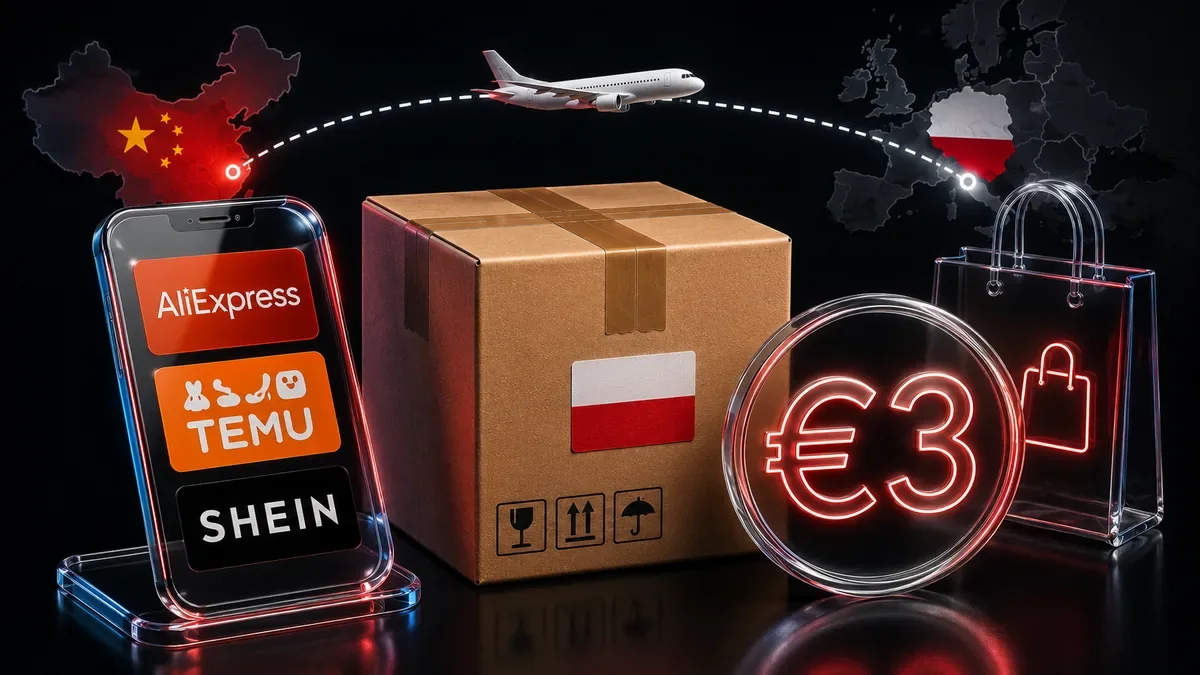
Short answer: since 1 July 2026, parcels under €150 no longer arrive duty-free. You now pay €3 for every type of item in the parcel. Five identical t-shirts cost €3; a t-shirt with a watch and a phone case costs €9. What matters is not the order total but how many different lines it contains.
The €3 customs duty on parcels from China in Poland in 2026
Parcels worth less than €150 used to arrive without customs duty. That relief is gone. Every tariff line — a type of goods under its customs code — is now charged €3.
The key word is "line", not "item". Five t-shirts of the same article are one line, so €3. A t-shirt, a watch and a case are three lines, so €9.
The rate is temporary and runs until 1 July 2028. After that the normal tariff returns, where the percentage depends on the type of goods.
VAT is a separate matter: it has applied to parcels from outside the EU since 2021. There is no special "AliExpress tax" or "Shein tax" in Poland — the general import rules apply.
Who actually pays the €3
Formally, not you. The duty is declared and paid by whoever clears the shipment: the marketplace or its logistics partner. No separate bill reaches the buyer, and there is no customs office to visit.
The money is still yours, though. Marketplaces build the duty into the item price or the delivery cost. So watch the checkout total with every fee included, not the price on the listing.
Four ways to avoid overpaying
1. Buy from a warehouse inside the EU. This is the big one. The platforms have been shipping stock into Europe in bulk for a while: Temu runs a Local-to-Local programme, AliExpress has Local+, and Shein is building a logistics hub near Wroclaw. If the goods are already inside the EU, no duty applies at the border, delivery takes days rather than weeks, and returns are easier. Look for an EU or Poland warehouse note on the listing.
2. Keep an order to one kind of product. Three pairs of the same socks cost €3. Socks, a charger and a mug cost €9. When you need several categories, a Polish shop is often cheaper once the duty is added.
3. Do not split the basket. Duty is counted per line on the declaration, not per parcel. Breaking one order into three shipments buys you nothing and may add carrier fees.
4. Compare the landed total, not the listing price. Add delivery, card conversion and any clearance fee to the discounted price. A €8 cable easily becomes €13 — while a Polish shop sells it for €12 and delivers tomorrow.
A worked example: a €40 order
Your basket holds a t-shirt, a phone case and a power bank. That is three different types of goods, so three lines at €3 each, or €9 of duty. Marketplace prices already include VAT, so start from those.
Add €3 of delivery and the €40 on the listing becomes €52. The same three items cost €58 in a Polish shop. The order still wins, but the gap is no longer double — it is €6 for a three-week wait.
Now the same order from an EU warehouse: no duty, €2 delivery, €42 in total. That is €10 saved, and the parcel arrives in days.
Warehouse in China
- €3 duty per line: Charged
- Delivery time: 2–5 weeks
- Returns: Shipped back to China
- Carrier clearance fee: Possible
Warehouse in the EU
- €3 duty per line: None
- Delivery time: 2–5 days
- Returns: Within Poland
- Carrier clearance fee: None
What it comes down to
- Compare the landed total with delivery and fees, not the price on the listing.
- Buy from an EU warehouse whenever the option exists: no duty and faster delivery.
- Keep one parcel to one kind of product so the declaration carries fewer lines.
Checking all of that by hand across a dozen tabs takes a while. At PromoPoland.pl we gather discounts from Polish and international shops in one place and refresh the feed daily, so one page is enough. It often turns out that the thing you were about to order from China is already discounted nearby — arriving tomorrow, with no duty and no waiting.
Have a look at AliExpress discounts or just open the main page and see what dropped in price today.
Sources and currency
Checked on 18 August 2026 against the EU regulation, the European Commission guidance, material from the Polish Ministry of Finance and Poczta Polska.